PEDIATRIC EMERGENCY

PEDIATRIC SUPPORT

Pediatric Support

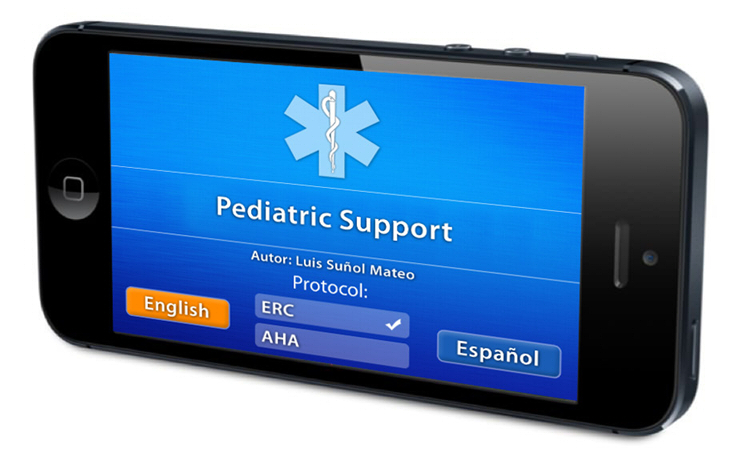
Pediatric Support it is an application addressed to health professionals since it requires specialized training for correct interpretation and use. The main objective is to facilitate integral handling in the Pediatric Advanced Life Support (PALS).

It is also very useful in the calculation of doses to administer many drugs necessary for managing a pediatric emergency situation.

You only need to configure the language and the procedure protocol –European Resuscitation Council (ERC) or American Heart Association (AHA)-, when installing the application.

This configuration can be changed from Settings.

When used Pediatric Support, prevents the device from going Sleep Mode.

The professional must type in the child's Age (the years and months) and Weight, and all functions in Pediatric Support will be automatically adjusted and calculated.

If you do not know either of these two values - is necessary that you know at least one of them, Age or Weight-, please type in the approximate values (p50) that are calculated with one of the Pediatric Support functions (Approximate estimated data). Once the information is loaded, press the VALIDATE button.

We will only need to select the mg/Kg to be administered on those drugs which require it due to medical practice.

Usage Input

Pediatric Support is composed by several different Functions such as:

Icon

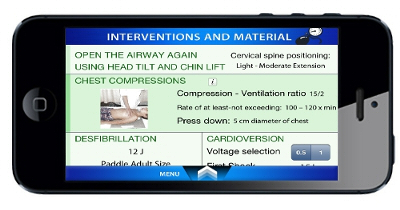
Interventions and Material

You can consult interventions to perform and all necessary material to be used during Pediatric Advanced Life Support (PALS), according to the guidelines 2025 of the ERC and AHA.

  • It explains airway management and the necessary material; cardioversion and defibrillation; how to do chest compressions, insertion of intraosseous access …
  • Mechanical ventilation: basic settings for ventilatory parameters are indicated, adequate to the child's characteristics.
  • Vital Constants are two graphs with Systolic Blood Pressure (SBP) and diastolic (DBP between the p5 and p95; heart rate and normal breathing frequency for the child's characteristics.
Feature Image

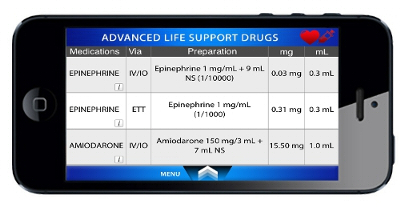
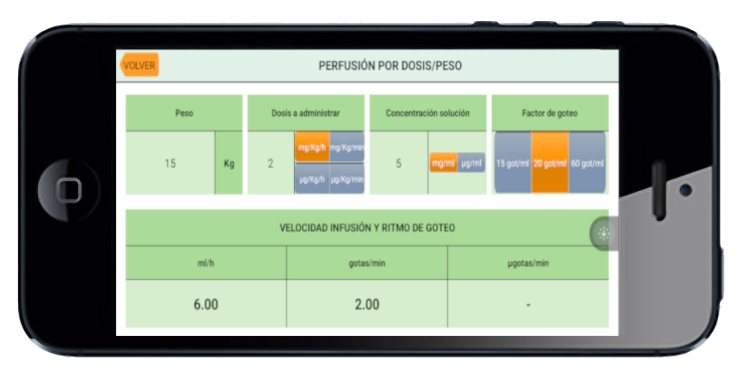
Pediatric Support indicates all drugs how to administer it, its preparation/dilution, the milligrams to be administrated in relation to the age and weight of child and millilitres to administrate once the drug is prepared/diluted.

Icon

Advanced Life Support Drugs

Are the specifications in the previously indicated guidelines 2025 ERC and AHA.

  • The display allows rapid visualization of the drug, which indicates how to perform dilution and milliliters of this we administer to provide the appropriate dose.
  • The drugs are: Amiodarone, Blood *, Calcium Chloride, Colloids, Crystalloids, Epinephrine, Lidocaine, Magnesium Sulfate and Sodium Bicarbonate.
Feature Image
Icon

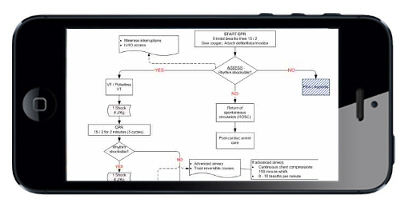
Algorithms and Tables

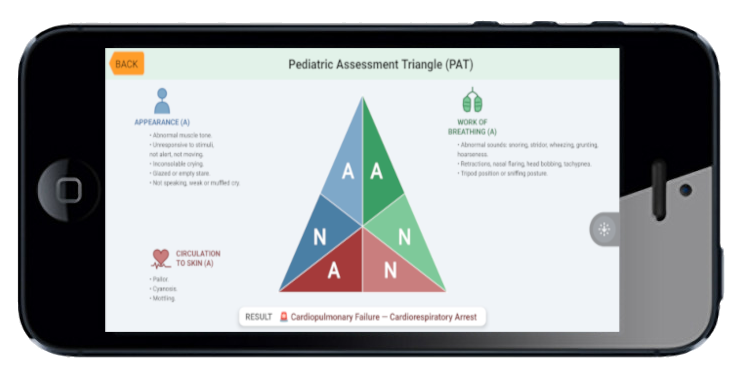
With this function you have access to 15 algorithms and tables allow quick consultation and decision making. The images can be expanded and browse them.

  • Airway Obstruction, foreign body, algorithm.
  • Anaphylaxis treatment, algorithm.
  • Asthma Pulmonary Score (PS).
  • Asthma Status, Management algorithm.
  • Basic Life Support, algorithm.
  • Burn, body surface area.
  • Convulsions, Management algorithm.
  • Epileptic status, Management algorithm.
  • Glasgow scale.
  • Induction anesthesia, rapid sequence.
  • Narrow Complex Tachycardia, algorithm.
  • Non-Shockable Rhythms.
  • Paim treatment, Table drugs.
  • Shockable Rhythms.
  • Wide Complex Tachycardia, algorithm.
Feature Image

Pediatric Support helps prevent mistakes that do not have to perform calculations in pressure moments in which we can have errors.

Icon

Parenteral Drugs

  • Are commonly used for handling convulsion crisis, status epilepticus, Paroxysmal Supraventricular Tachycardia (PSVT), anaphylactic shock, sedation, anaesthesia, analgesia, asthmatic status, intoxications, etc ...
  • The drugs are: Adenosine, Albuterol/Salbutamol, Amiodarone, Atropine, Biperiden, Dexamethasone, Dexchlorpheniramine, Diazepam, Epinephrine, Etomidate, Fentanyl, Flumazenil, Furosemide, Glucagon, Glucose, Hydrocortisone, Ketamine, Ketorolac, Labetalol, Levetiracetam, Lorazepam, Magnesium Sulfate, Meperidine, Metamizole, Methylprednisolone, Metoclopramide, Midazolam, Morphine, Naloxone, Neostigmine, Octreotide, Omeprazole, Ondansetron, Paracetamol, Phenobarbital, Phenytoin, Procainamide, Propofol, Ranitidine, Rocuronium, Succinylcholine, Theophylline, Thiopental, Tramadol, Urapidil, Valproic Acid and Vecuronium.
Icon

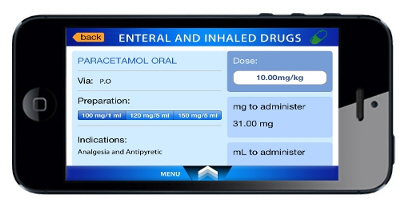
Enteral and Inhaled Drugs

  • Are commonly used for handling convulsion crisis, anaphylaxis, sedation, analgesia, asthmatic status, intoxications, etc ...
  • The drugs are: Acetylcysteine (NAC), Activated Charcoal, Albuterol/Salbutamol, Budesonide, Codeine, Dexchlorpheniramine, Diazepam, Diclofenac, Epinephrine, Ibuprofen, Ipecac Syrup, Ipratropium Bromide, Loratadine, Metamizol, Midazolam, Paracetamol, Prednisone and Prednisolone.
Feature Image
Icon

Intravenous Infusions

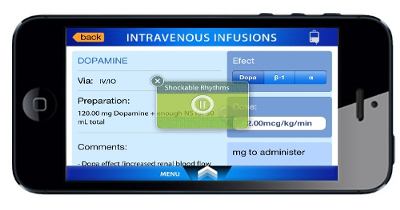
There are a total of 19 drugs: Acetylcysteine (NAC), Amiodarone, Dobutamine, Dopamine, Epinephrine, Fentanyl, Flumazenil, Isoproterenol, Ketamine, Labetalol, Midazolam, Nitroglycerin, Nitroprusside, Norepinephrine, Octreotide, Propofol, Thiopental, Valproic Acid and Vecuronium.

Icon

Rate Chest Compressions

Sound with 110 beats per minute, which helps to keep a constant pace for thoracic compressions. The sound can be paused and restarted at any time.

Icon

Timer

It allows a timer to be set up which counts the time devoted to advanced vital support.
You can pause, restart and reset the counter to zero at any time.

Pediatric Support can be active simultaneously the Functions Rate Chest Compressions, Timer and Guides Shockable or Non-Shockable Rhythms, and in turn consult any of the functions of Drugs, Algorithms and Tables or Interventions and Material.

Icon

Shockable Rhythms Guide

Audio guide which indicates the algorithm sequence.
The sequence is reproduced in a rhythm is based on the indications given by the ERC and AHA.

Feature Image
Icon

Non Shockable Rhythms Guide

Audio guide which indicates the algorithm sequence.
The sequence is reproduced in a rhythm is based on the indications given by the ERC and AHA.

Icon

Notes

Pediatric Support includes a custom Notes system that allows you to create, save, edit and delete personal annotations to suit your clinical needs.

You can create notes to record relevant information during patient care, add reminders, your own protocols or any reference you find useful. Each note is stored locally on the device and is available at any time, without the need for an internet connection.

Manage your notes intuitively: create them whenever you need, edit them when information needs to be updated, and delete them when they are no longer needed.

The audio guides can be paused and resumed at any time. When the audio is resumed, it will continue from the point it was paused.

If audio guide is enabled, the function Rate Chest Compressions will be played in the background, to keep the thoracic compression frequency.

This can be changed from the Defibrillation Rhythm Guide to the Non-Defibrillation Rhythm Guide, depending on the child's situation. This change of Guide can also be done during the following 30 seconds after Cardiac Rhythm Evaluation. After that time, the Guide cannot be changed until algorithm sequence Cardiac Rhythm Evaluation is not reached again.

When changes are made between guides, the application controls the adrenaline which has been administered, as well as the discharges made, initiating the algorithm at the correct sequence.

Pediatric Support can be used as training application of the Shockable Rhythms and Non-Shockable Rhythms Algorithms, through the Function Guide.

Bibliography
Bibliography
Pediatric Support Video